Jesper Bentzer
LEVEL. NARRATIVE. DESIGN
Kung Kong
Kung Kong is a intense pick-up & play arcade game that gets inspiration from air hockey and pong.
Play PvE or go head-to-head against another person in PvP.

Genre
Casual - Arcade - Local Multiplayer
Platform
PC
Tools
Unity
Visual Studios
Unity - Github
Production Time
2 Weeks
Team size
4 students
2 Game Designers
1 Programers
1 2D Artist
Role
Gameplay designer - Co-scripting
Contribution
Game vision & main features design, production owner
Key Learning
- Learned how to Creating a polished game in Unity with a focused scope.
-
Got a better understanding of how you can take the familiar gameplay, yet put a spin on it to allow players to experience it in new engaging ways.
- Gained deeper insight into how you can create games that are just as much fun to watch as they are to play.
Personal Contribution
- To make sure we kept the theme of the game by communicating with the Artists, programmers and other Designers.
- Planed out the core concept of the gameplay and what to focus on.
- QA bug testing and making sure that everything new was still working after it was added to the game.
- Created the level and managed the block-out from white boxing to finished game.
Itch.Io Link
Screenshots


The Game Design
When we work on Kung Kong one important thing that came up was how do we make it fun? We did so by establishing 4 key pillars:
- Fast-paced
- Music
- Colors
- Strong feedback
This then guided us throughout development. For example, the satisfying sound of the ball making an impact, the vibrant playspace with the emotive monkeys, the icon on the points reward and how the ball kept increasing in speed.
The player character
The player character was one of the first things we created after we got the neon theme for the game nailed down, we needed it to be easy to understand and look at while also giving it some personality.
Since most of the player feedback would come from the monkeys they controlled (their avatars in the game), I wanted to ensure that the monkeys had personalities and always gave feedback to the player.
II did so by working tightly with our 2D artist to flesh out the visual personality of the monkeys. For example when the monkeys got hit with a ball or if the player tried to serve without a ball the monkeys would react accordingly in an emotive way.
All to ensure that it felt good when playing the game
And for each time the ball hit the character or a wall it increased in speed by a slight
percentage and would keep increasing until one of the players scored.
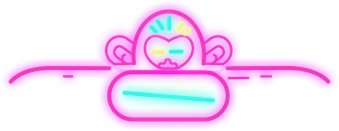
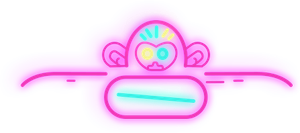

We also had a different animation for when a player successfully served the ball adding small lightning bolts coming out from its head to different between the feedback the player got so that they would know they
successfully hit the ball.
If a player served the ball succeesfuly it would increase the balls speed dramatically it was created to keep the speed theme up and keep the player's mind focused on the game as the ball would just keep increasing in speed normally and then fly at incredible speed when smashed.
The way to play it
Kung Kong was made with the idea to be played as an arcade game, taking inspiration from air hockey by using 2 screens lying down on a table to allow everyone to watch the gameplay and cheer on. This was made intentionally to make really sell that arcade feeling by also working with the colors and sounds of the game.

Internal QA testing
Whenever we made a new change to the game like the abilities, found a bug or added something new it was my job to test it out in different ways, write down what I found and bring it up with the rest of the group to decide what could be done.
Since we only had 2 weeks to finish the game we had to spend as much time as possible and work efficiently to find and fix all bugs and unintended features that we didn't want in the game.
Some of these bugs stayed in the game as unintentional features.
Wall Trick-shoot
One such unintentional feature was what I call the Trick-shoot if you could ram the paddle (the monkey) into the ball on the small side of the paddle and then into the wall you could get a power shoot.
Once I found this bug and played around with it a bit and found it to just add to the enjoyment and gameplay we were after in the game as a trick-shoot players could perform one they mastered the game, and after speaking to the team and telling them why it should be kept as it is they all agreed.